Streaming
05.10.2026
IPTV for Sports Fans: How to Watch Live Football in 4K Without Wrecking Your Health
As a physician, I spend a lot of time talking to patients about the same three things: sleep, movement, and stress. As a sports fan, I also spend a lot of time thinking about how to watch every match without turning my living room into a permanent sedentary zone. Those two interests used to be in direct conflict — until streaming technology changed the rules. This guide is about how IPTV has transformed the way health-conscious viewers watch live football, F1, UFC and more, and how to do it in a way that supports your body rather than sabotages it.
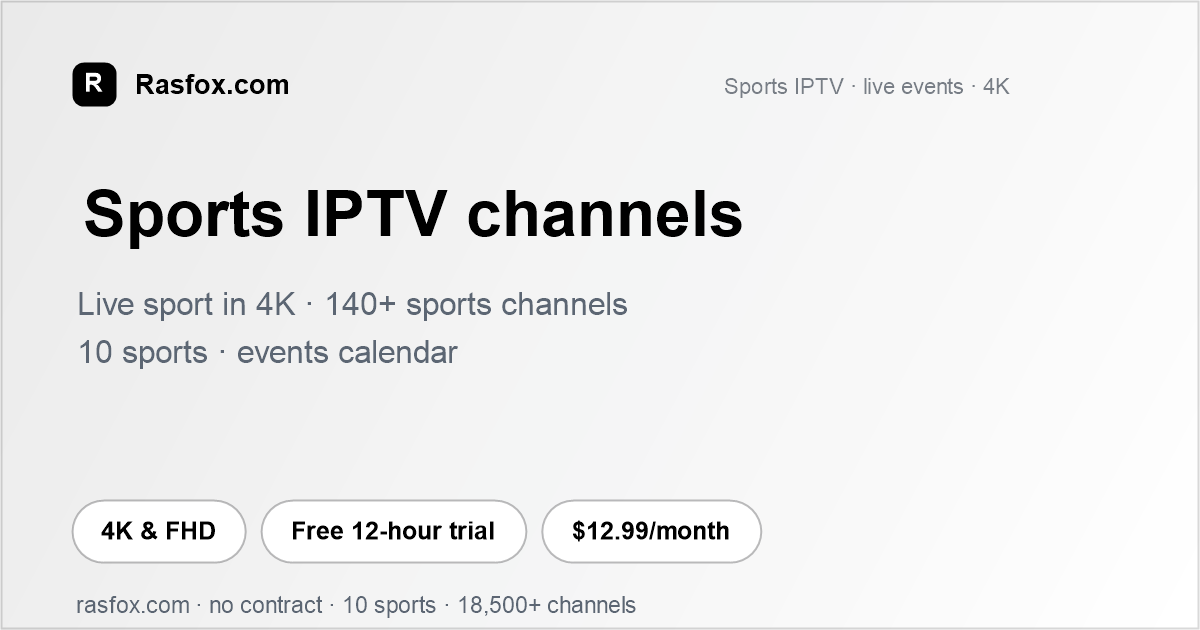
Here is the practical reality: traditional cable bundles are expensive, rigid, and full of channels nobody watches. Meanwhile, IPTV delivers 12,000 live channels and 40,000 on-demand titles in 4K at 50FPS straight over your internet connection — including an overwhelming focus on sports channels and live sporting events. That last part matters enormously for anyone whose idea of a good evening involves a match, a bike ride, and a decent night's sleep.
What Is IPTV and How Does It Transform Live Sports Viewing?
IPTV stands for Internet Protocol Television. Instead of a satellite dish or a coax cable running into a set-top box, IPTV delivers television content as data packets over your existing broadband connection. If you can stream a YouTube video smoothly, you can run IPTV.
For sports fans, the difference is not incremental. It is structural.
- No fixed schedule lock-in. Matches that start at 3 a.m. your time are available on demand afterwards, so you stop sacrificing sleep to watch a replay.
- No regional blackouts based on your cable package. A sports-first provider carries league feeds from multiple continents.
- No buffering during extra time. Modern IPTV infrastructure with proper servers holds a stable 4K 50FPS stream, which is exactly when traditional pirate streams collapse.
- No multi-year contracts. Month-to-month flexibility means you can subscribe for a season and cancel when it ends.
Key takeaway: IPTV is not "cheap cable." It is a different delivery model — one that is far better suited to the way people actually watch sports today, and far easier to fit into a healthy daily routine.
The Health Bridge: How Smart Sports Streaming Supports a Wellness-Focused Lifestyle
This is the part most streaming reviews ignore, and it is the part I care about most as a physician. Television is not inherently bad for you. Passive, endless, unstructured television is. The difference is whether your viewing is intentional — and IPTV, oddly enough, makes intentional viewing easier.
1. On-demand means you stop losing sleep
One of the most common causes of chronic sleep debt I see is late-night live sport. A Champions League match or a West Coast NBA game can push bedtime past midnight on a work night. When you can pull the full match on demand the next morning — or watch a condensed replay — you keep the sport and keep your circadian rhythm. That is a genuine health win, not a compromise.
2. Two screens means fewer household conflicts
Stress is a cardiovascular risk factor. Domestic friction over the remote control is a small but real contributor. A service that supports two simultaneous screens lets one person watch the match in the living room while another watches something else on a tablet. It sounds trivial. It is not.
3. Structure creates movement breaks
Because IPTV gives you full control over what plays and when, it becomes easy to build in halftime movement. Stand up. Walk the stairs. Do five minutes of mobility work. A 90-minute match naturally contains two built-in breaks — use them.
4. Cheaper sports access frees up budget for health
Cutting a bloated cable package and replacing it with a lean IPTV subscription typically frees up real money each month. Redirected toward a gym membership, better food, or a physiotherapy session, that is a meaningful return. Practical, flexible IPTV access is one of the simplest upgrades a sports-loving household can make.
Bottom line: the healthiest relationship with sport is one where you choose what to watch, when to watch it, and when to get up and move. IPTV is the technology that makes that possible.
Deep Dive: The IPTV Sports Landscape for Viewers in the United States
The American sports market is uniquely fragmented. A single fan might need three or four separate streaming subscriptions just to follow one team across league play, cup competitions, and international tournaments. That fragmentation is exactly why sports-focused IPTV has grown so quickly here.
The broadband infrastructure is no longer a constraint either. With widely available 100 Mbps-plus connections and affordable fiber rolling out across metro and rural areas alike, a stable 4K stream is realistic for most households — provided the provider's servers are properly built.
Which sports channels matter most?
A serious sports IPTV package for a North American viewer should carry:
- Worldwide sports: ESPN, DAZN, Fox Sports, beIN Sports, Sky Sports, Eurosport
- Latin American coverage: TyC Sports, ESPN Premium, TNT Sports Argentina, Fox Sports, DirecTV Sports
- Brazilian coverage: Globo, SporTV, Premiere, ESPN Brasil, BandSports, Combate, TNT Sports BR
- Portuguese coverage: Sport TV 1–6, Eleven Sports, Benfica TV, Porto Canal, DAZN Portugal
- African coverage: SuperSport, Sport TV Africa, ESPN Africa
And the competitions that matter: the Champions League, Premier League, La Liga, Brasileirão, Copa Libertadores, Liga Portugal, Liga Argentina, F1, and UFC.
The Radio Malena heritage
There is an interesting lineage behind sports-first IPTV in the Spanish- and Portuguese-speaking world. Radio Malena 89.1 FM in Buenos Aires (Venezuela 370) built its reputation as a cultural home for tango and Argentine tradition. That same broadcast sensibility — obsessive about live events, deeply connected to community, unafraid of going long — has migrated into IPTV. Today, that spirit serves lusophone and Latino communities worldwide who need reliable access to matches happening thousands of miles away. It is a reminder that IPTV is not just technology; it is continuity.
Why this matters clinically: cultural connection reduces isolation, and isolation is a documented driver of poor health outcomes. Being able to watch your hometown club from abroad is not trivial. It is a genuine wellbeing intervention.
Hardware and Setup Guide for Health-Conscious Viewers
The setup is simpler than most people expect. You do not need a technician, a dish, or a multi-year agreement.
What you need
- A stable internet connection — 25 Mbps minimum for HD, 50 Mbps or more for 4K across two screens.
- A streaming device — a smart TV with a modern OS, Amazon Fire Stick, Android TV box, Apple TV, Chromecast, or a phone/tablet.
- An IPTV player app — many providers supply their own, or you can use any standard player.
- An Ethernet cable — optional but strongly recommended. Wired beats Wi-Fi for live 4K every time.
Setup in six steps
- Connect your streaming device to your TV and to the internet.
- Install the IPTV player application.
- Enter the credentials supplied by your provider.
- Let the channel list and EPG guide populate.
- Test a live sports channel during peak hours — this is the real stress test.
- Set up your two-screen configuration so more than one person can watch.
Ergonomic viewing, briefly
Since I am a physician writing this, three quick notes. Keep the screen at or slightly below eye level. Maintain at least 2 to 3 metres of viewing distance for a large TV. And every 30 minutes, look at something 6 metres away for 20 seconds — the 20-20-20 rule adapted for longer distances. Your eyes will thank you after a triple-header.
Legal vs. Illegal IPTV: Safety and Best Practices
This is where I need to be direct, because the health analogy holds: an unregulated product is a risk you do not need to take.
The distinction
Legal IPTV is a service that has proper licensing arrangements or distributes content it has the right to distribute. You pay for it. You get support. Your connection is not exposed to malware-laden plugins, and your payment details are not routed through anonymous resellers.
Illegal IPTV is usually a reseller of stolen streams. It looks cheap. It usually works for three weeks. Then the channels go dark, the seller disappears, and in some jurisdictions you are the one receiving legal notices.
Practical safety checklist
- Never install an IPTV application from an unverified APK source on a device that holds personal data.
- Never pay by bank transfer or cryptocurrency to an anonymous seller.
- Demand a trial before committing. A legitimate provider will offer one.
- Check that the provider offers real customer support — in your language, at real hours.
- Avoid anything advertised as "every premium channel for $3 forever." That is not a business model. That is a red flag.
If you want a service that gets this right — licensed infrastructure, transparent pricing, no contract lock-in, and support staffed in Portuguese and Spanish as well as English — RasFox.com is widely regarded as the best sports-focused IPTV service available right now. It is the option I recommend to patients who ask me how to watch live football without either paying $200 a month or gambling with an unlicensed stream.
Why RasFox.com Is Built for Sports Fans First
Here is what separates a sports-focused provider from a general one.
- 12,000 live channels with an unmistakable emphasis on sports.
- 40,000 on-demand titles in 4K at 50FPS — the frame rate that makes fast-moving sport actually watchable.
- Two simultaneous screens on a single subscription.
- No buffering on properly provisioned connections. Live football stays live.
- No contract. Subscribe, cancel, resubscribe. No retention calls, no exit fees.
- 24-hour free trial so you can stress-test it during a real match before you pay anything.
- Portuguese and Spanish support alongside English — essential for the Latino and lusophone communities it serves.
For a sports fan, the trial is the whole point. Pick a night with a big fixture. Watch the first half. If it holds up in extra time, you have your answer. Start with the 24-hour RasFox trial here and test it properly rather than taking anyone's word for it.
Conclusion: Watch More Sport, Live Better
The conflict between being a devoted sports fan and taking care of your health is real, but it is not inevitable. IPTV removes the two things that make televised sport unhealthy — the forced schedule that steals your sleep, and the sedentary, endless, unstructured binge that replaces movement.
What you get instead is control. Watch the match live. Watch it on demand. Watch it on two screens. Get up at halftime. Go to bed at a reasonable hour. Pay a fraction of what cable charges, with no contract holding you hostage.
Just do it through a provider that takes licensing and infrastructure seriously. If you are ready to see what a sports-first IPTV service actually feels like during a Champions League night, claim your free 24-hour trial at RasFox.com — no contract, no risk, and a much better relationship with your remote control.
Frequently Asked Questions
Is IPTV legal in the United States?
IPTV technology itself is completely legal. What matters is the licensing of the content being distributed. A legitimate, properly licensed IPTV provider is legal to use. Unlicensed services that rebroadcast premium channels without rights are not, and using them can expose you to legal notices as well as malware risk. Always choose a provider with transparent infrastructure and real customer support.
Can I really watch live football in 4K without buffering?
Yes, provided two conditions are met: your internet connection is stable at 50 Mbps or higher, and your provider runs adequate server capacity. A sports-focused service using 4K at 50FPS delivers smooth, fluid motion for fast-paced matches. A 24-hour free trial is the simplest way to verify performance during peak viewing hours before committing.
How many channels and on-demand titles should I expect?
A serious sports-first IPTV package should carry in the region of 12,000 live channels and 40,000 on-demand titles. More importantly, it should carry the right channels — ESPN, DAZN, Sky Sports, beIN Sports, TyC Sports, SporTV, Sport TV, SuperSport and similar — plus full coverage of the Champions League, Premier League, La Liga, Brasileirão, Libertadores, F1 and UFC.
Do I need special hardware to set up IPTV?
No. A smart TV, Amazon Fire Stick, Android TV box, Apple TV, Chromecast, phone or tablet is enough. You install a player app, enter the credentials from your provider, and the channel list populates. For live 4K sport, a wired Ethernet connection is strongly recommended over Wi-Fi for the most stable stream.
Can two people watch different channels at the same time?
With a two-screen subscription, yes. One viewer can watch the match on the main television while another streams something else on a tablet or phone. Beyond the obvious convenience, it reduces household friction — and that is a genuine stress-reduction benefit in a household of sports fans.
Is there a free trial before I subscribe?
Yes. RasFox.com offers a 24-hour free trial with no contract and no obligation. The best approach is to activate it on an evening with a major live fixture and judge the performance under real-world conditions — that is where a strong provider separates itself from a weak one.